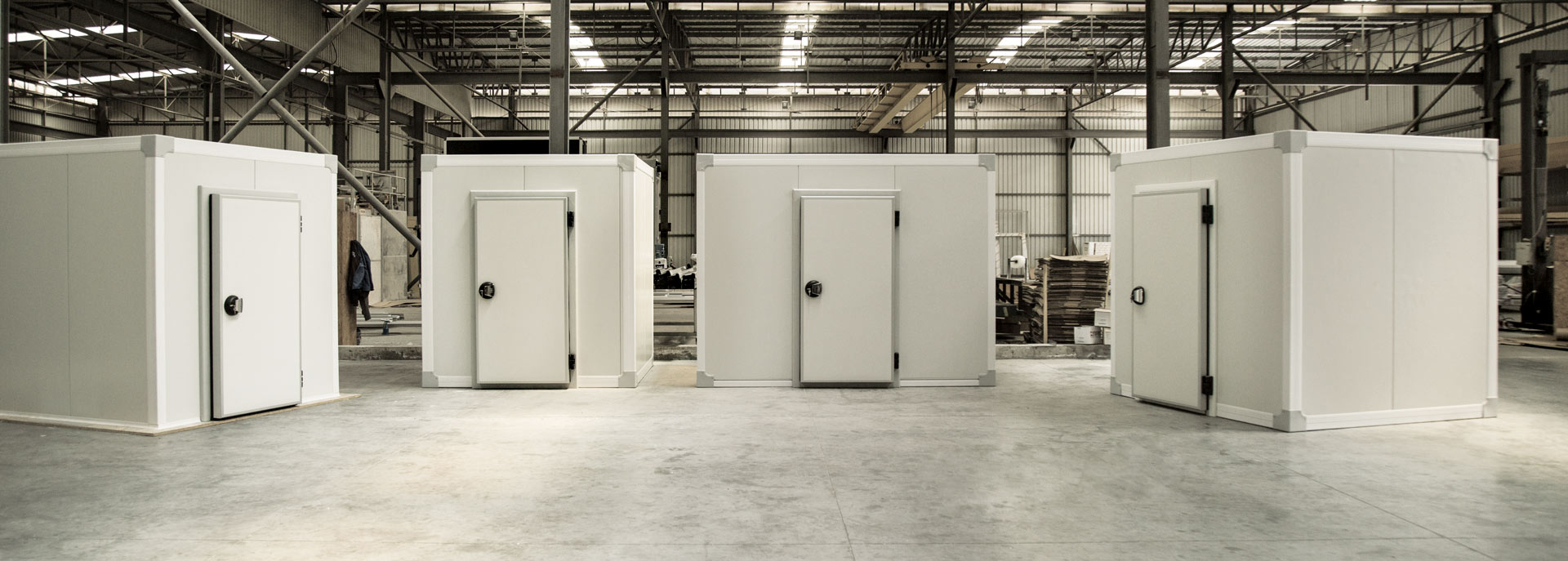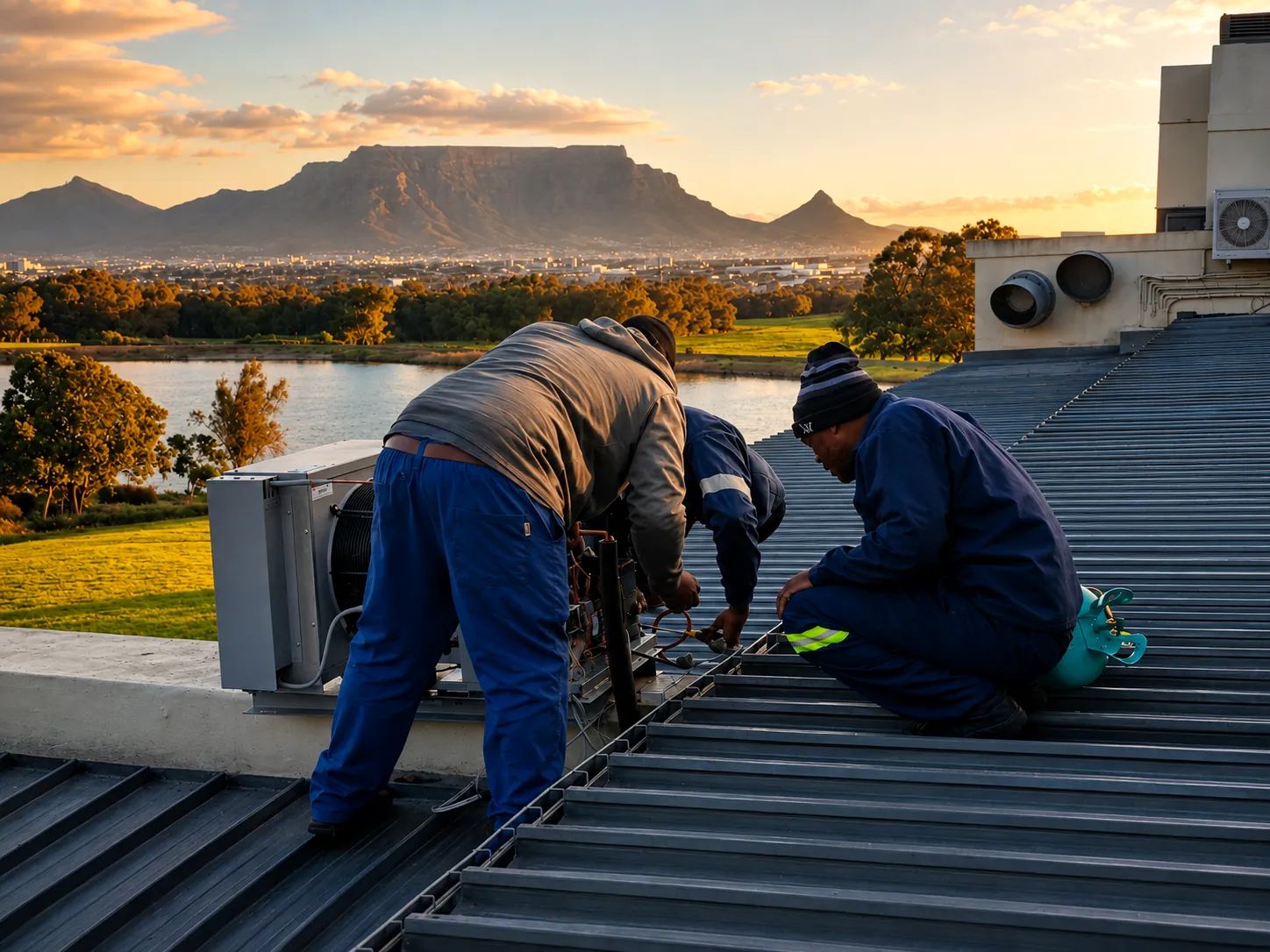
A commercial cold room does not have one standard electricity-consumption figure.
Two cold rooms with identical dimensions can use very different amounts of electricity because power consumption depends on much more than room size. The required temperature, insulation, product load, door usage, ambient heat, condenser location, refrigeration equipment and maintenance condition all affect how long the system must run.
The main factors influencing cold room electricity consumption are:
- Room dimensions
- Required operating temperature
- Insulated panel type and thickness
- Door-opening frequency
- Ambient temperature
- Condenser ventilation
- Refrigeration-system efficiency
- Quantity and temperature of incoming products
- Temperature-controller settings
- Defrost operation
- Fan and lighting loads
- Equipment condition
- Preventative maintenance
- Staff operating practices
Cold rooms often operate throughout the day and night. Even relatively small inefficiencies can therefore produce substantial additional electricity use over a month or year.
The only reliable way to establish a particular room’s consumption is to measure it using an electricity meter or energy-monitoring system. However, businesses can create a useful preliminary estimate from the equipment’s electrical demand and actual operating time.
How Much Electricity Does a Cold Room Use?
A cold room’s electricity consumption is measured in kilowatt-hours, or kWh.
The basic calculation is:
Electricity consumption = electrical power in kilowatts × operating time in hours
For example, a piece of equipment drawing 3kW continuously for one hour consumes:
3kW × 1 hour = 3kWh
However, a refrigeration compressor does not necessarily run continuously. It normally cycles on and off according to room temperature and system demand.
This means that the following calculation would usually be inaccurate:
Compressor rated power × 24 hours
A better preliminary estimate is:
Daily consumption = running electrical demand × compressor runtime per day
The calculation must then include any components that consume power separately, such as:
- Evaporator fans
- Condenser fans
- Defrost heaters
- Drain heaters
- Door-frame heaters
- Lighting
- Controllers
- Monitoring equipment
- Crankcase heaters
The compressor is normally the largest load, but it is not the only electrical component.
Why There Is No Universal Cold Room Power-Consumption Figure
Cold-room energy use is determined by the amount of heat the refrigeration system must remove.
Heat enters or is generated through several routes:
- Heat passes through the walls, ceiling and floor.
- Warm air enters whenever the door opens.
- Products introduce heat when they enter above storage temperature.
- People, lights and fan motors produce heat inside the room.
- Defrost heaters deliberately introduce heat to clear evaporator ice.
- Refrigeration equipment produces electrical and mechanical losses.
- Poor controls may cause unnecessary cooling, fan operation or defrosting.
The refrigeration system must remove this heat while maintaining the required storage temperature.
Danfoss advises that efficient walk-in cooler and freezer operation begins with matching the system to the intended temperature, product, humidity, airflow, loading pattern and frequency of door openings. It also identifies correctly selected components and controls as central to overall efficiency.
A general online claim that a “3 × 3 metre cold room uses a certain number of units per day” is therefore unlikely to be reliable unless it states the complete design and operating conditions.
Cold Room Energy Use Is Not the Same as Equipment Rating
The electrical rating on a compressor or condensing unit shows its power demand under stated operating conditions. It does not necessarily show the complete cold room’s daily energy use.
The actual consumption depends on:
- How often the compressor operates
- How heavily it is loaded
- Condensing temperature
- Evaporating temperature
- Refrigerant type
- Fan power
- Defrost energy
- Controller operation
- Voltage conditions
- Equipment efficiency
- Room usage
A compressor labelled at approximately 3kW does not automatically consume 72kWh every day.
If it runs for eight accumulated hours during a 24-hour period, the simplified compressor consumption would be:
3kW × 8 hours = 24kWh per day
If operating conditions cause it to run for 18 hours, consumption becomes:
3kW × 18 hours = 54kWh per day
That difference in runtime is why insulation, condenser ventilation, door control and product loading matter so much.
A Simple Cold Room Electricity Calculator
Use the following method for a preliminary estimate.
Step 1: Identify the running power
Record the rated or measured electrical demand of:
- Compressor
- Condenser fans
- Evaporator fans
- Defrost heaters
- Door heaters
- Lighting
- Other controls or accessories
The equipment nameplate can provide a starting point, but measured power is more accurate because actual demand changes with operating conditions.
Step 2: Establish daily operating hours
Use:
- Controller runtime records
- An hour meter
- Energy-monitoring equipment
- Building-management data
- A temporary data logger
- Technician measurements
Do not guess compressor runtime from the sound of the unit over a short period.
Step 3: Calculate each load separately
Component kWh = component kW × operating hours
Step 4: Add the components
Total daily kWh = compressor + fans + heaters + lights + controls
Step 5: Calculate the approximate cost
Electricity cost = total kWh × applicable electricity rate
The applicable rate should come from the business’s actual electricity account or tariff schedule.
South African businesses may be supplied directly by Eskom or through a municipality, and tariffs can include more than a simple energy charge. Depending on the customer category, the account may contain fixed charges, capacity charges, demand charges, seasonal rates or time-of-use pricing. Eskom confirms that its tariff structure contains different urban, rural, municipal and customer categories rather than one universal rand-per-kWh price.
For the 2026/2027 period, revised Eskom direct-customer tariffs took effect on 1 April 2026, while local-authority tariff adjustments took effect on 1 July 2026. Eskom reported an average standard-tariff adjustment of 8.76% and an average local-authority adjustment of 9.01%, but the actual amount paid by an individual business still depends on its supplier and tariff category.
Worked Electricity-Consumption Example
Consider a hypothetical positive-temperature cold room with the following measured loads:
- Compressor and condensing-unit fans: 3.2kW
- Evaporator fans: 0.3kW
- Lighting: 0.08kW
- Controller and minor accessories: 0.02kW
Assume:
- Condensing unit operates for 10 accumulated hours per day
- Evaporator fans operate for 22 hours per day
- Lighting operates for 2 hours per day
- Controls operate continuously
Condensing unit
3.2kW × 10 hours = 32kWh
Evaporator fans
0.3kW × 22 hours = 6.6kWh
Lighting
0.08kW × 2 hours = 0.16kWh
Controls
0.02kW × 24 hours = 0.48kWh
Estimated daily consumption
32 + 6.6 + 0.16 + 0.48 = 39.24kWh per day
Estimated monthly consumption
For a 30-day month:
39.24kWh × 30 = 1,177.2kWh per month
This example is not a prediction for a particular cold room. The actual result could be substantially higher or lower depending on equipment capacity, runtime, temperature, loading and environmental conditions.
A freezer room would also need allowances for active defrost heaters, drain heaters and possibly door-frame heaters.
The Most Accurate Way to Measure Cold Room Electricity Use
The best method is to install a suitable submeter on the refrigeration circuit.
A submeter can record:
- Total kWh
- Daily consumption
- Peak demand
- Operating patterns
- Compressor starts
- Changes after maintenance
- Changes after deliveries
- Seasonal differences
- Overnight base load
- Abnormal continuous operation
Where several systems share one electrical supply, each system may need separate monitoring to identify the inefficient room.
Temporary clamp meters can provide useful measurements during an assessment, but long-term metering gives a better picture because refrigeration load changes throughout the day and across seasons.
Businesses should compare similar periods—for example, one full summer month before and after an efficiency improvement—rather than comparing a cool winter week with a hot summer week.
What Affects Cold Room Electricity Consumption?
1. Room Size
A larger room usually has:
- More wall area
- More ceiling area
- Greater internal volume
- More stored product
- Longer pipe runs
- More lighting
- Larger or additional evaporator fans
This can increase both the refrigeration load and auxiliary electricity use.
However, energy use does not increase according to floor area alone.
A tall, compact room may have a different panel surface area and storage efficiency from a long, low room with the same internal volume.
The room’s shape also matters. A compact rectangular enclosure generally has less external surface area than a highly irregular room containing the same volume. Less surface area can mean less transmission heat gain, assuming equal insulation and exposure.
An oversized room also cools unused space. Businesses should choose dimensions according to peak stock, shelving, aisles, airflow and realistic growth rather than installing the largest enclosure that can fit.
2. Operating Temperature
The lower the required room temperature, the harder the refrigeration system must work.
Suppose the area around the cold room reaches 30°C:
- A room at +5°C has an approximate temperature difference of 25°C.
- A room at 0°C has an approximate difference of 30°C.
- A freezer at −18°C has an approximate difference of 48°C.
A larger temperature difference increases heat transfer through the enclosure.
Lower evaporating temperatures can also reduce refrigeration-system efficiency because the compressor must operate across a greater pressure difference.
This is why a freezer room normally consumes more electricity than an otherwise similar positive-temperature cold room.
The controller should be set according to the product’s actual storage requirement. Reducing the setpoint below what the product needs introduces unnecessary refrigeration work.
South African energy-efficiency guidance for refrigeration notes that increasing a refrigeration thermostat by only 1°C can reduce energy use, although the exact saving varies with the system and application. Product-safety requirements must always take priority over energy reduction.
3. Insulated Panel Type and Thickness
The insulated enclosure limits heat entering the room.
Thermal performance depends on:
- Insulation material
- Panel thickness
- Thermal conductivity
- U-value
- Panel age
- Joint design
- Installation quality
- Moisture condition
- Thermal bridging
Thicker insulation generally reduces transmission heat gain when the same insulation material is compared.
However, equal thickness does not mean equal performance. Polyurethane, PIR and expanded-polystyrene cores can have different thermal properties.
Insulation should be selected according to:
- Required room temperature
- Maximum ambient temperature
- Indoor or outdoor location
- Direct sunlight
- Expected operating life
- Electricity cost
- Available internal space
For freezer rooms, greater insulation is generally required because of the larger temperature difference. Danfoss notes that deep-freeze rooms normally use a greater insulation thickness than positive-temperature rooms.
Panel joints matter too
A room with thick panels can still waste energy when warm air enters through:
- Open panel joints
- Damaged corners
- Unsealed pipe penetrations
- Door frames
- Floor junctions
- Ceiling connections
The complete thermal envelope must remain continuous and dry.
4. Door-Opening Frequency
Opening a cold room door introduces warm air and moisture.
The refrigeration system must then:
- Cool the incoming air.
- Remove moisture from it.
- Restore the room to its set temperature.
- Defrost additional ice that forms on the evaporator.
The impact depends on:
- Door dimensions
- Number of openings
- Length of each opening
- Difference between indoor and outdoor temperature
- Surrounding humidity
- Air movement around the door
- Whether trolleys or pallets hold the door open
- Door-seal condition
Danfoss identifies door-opening frequency as an important application input and recommends door-management controls as part of an efficient walk-in system.
Ways to reduce door-related energy use
- Prepare stock before opening the door.
- Keep the opening period as short as practical.
- Use self-closing doors where suitable.
- Maintain door gaskets and hardware.
- Fit strip curtains for appropriate applications.
- Avoid positioning the evaporator so cold air discharges directly toward the doorway.
- Install door-open alarms.
- Use fast-closing doors in high-traffic facilities.
- Consider an ante-room for heavily used freezers.
Danfoss notes that strip or air curtains can reduce temperature fluctuations by limiting heat entering during staff access.
5. Damaged Door Seals
A door does not need to be visibly open to waste electricity.
A damaged gasket can allow a continuous stream of warm, humid air into the room.
Warning signs include:
- Condensation around the door
- Ice on freezer-room frames
- Torn gasket material
- Light visible through the closed doorway
- Door requiring excessive force to close
- Uneven gasket contact
- Long compressor runtime
- Ice on the evaporator
Repairing a door seal can reduce both sensible heat from warm air and latent load from moisture.
Door alignment should also be checked. Replacing the gasket alone will not solve leakage caused by worn hinges, damaged rollers, a bent door or an uneven floor.
6. Ambient Temperature
A cold room installed in a cool warehouse has a different load from an identical room exposed to:
- A hot commercial kitchen
- Direct sunlight
- A metal roof
- Outdoor summer temperatures
- Heat rejected by nearby equipment
- Poor ventilation
Higher ambient temperature affects both sides of the system.
Effect on the room enclosure
The greater temperature difference increases heat transfer through the panels.
Effect on the condenser
Hotter condenser air makes heat rejection more difficult. Condensing pressure rises and compressor efficiency falls.
This explains why a room may perform acceptably overnight but run for much longer during the hottest part of the day.
Outdoor panel surfaces may need:
- Greater insulation
- Shading
- Reflective finishes
- Weatherproof roofing
- Adequate ventilation around the condenser
The condenser should not discharge hot air into a small enclosed space where the same heated air is repeatedly drawn back through the coil.
7. Condenser Ventilation
The condenser transfers heat from the refrigeration system to the surrounding air.
For efficient operation, it needs:
- Adequate fresh airflow
- Clear air intake
- Clear hot-air discharge
- Sufficient distance from walls
- No hot-air recirculation
- Clean coil surfaces
- Correct fan operation
Government energy guidance for commercial refrigeration advises locating condensers and heat exchangers where heat can be discharged effectively and where good airflow is available.
Poor condenser positioning can cause:
- High condensing pressure
- Longer compressor runtime
- Reduced cooling capacity
- High-pressure trips
- Increased electricity use
- Compressor overheating
- Shorter equipment life
Do not surround the condensing unit with boxes, stored materials or decorative screening that restricts airflow.
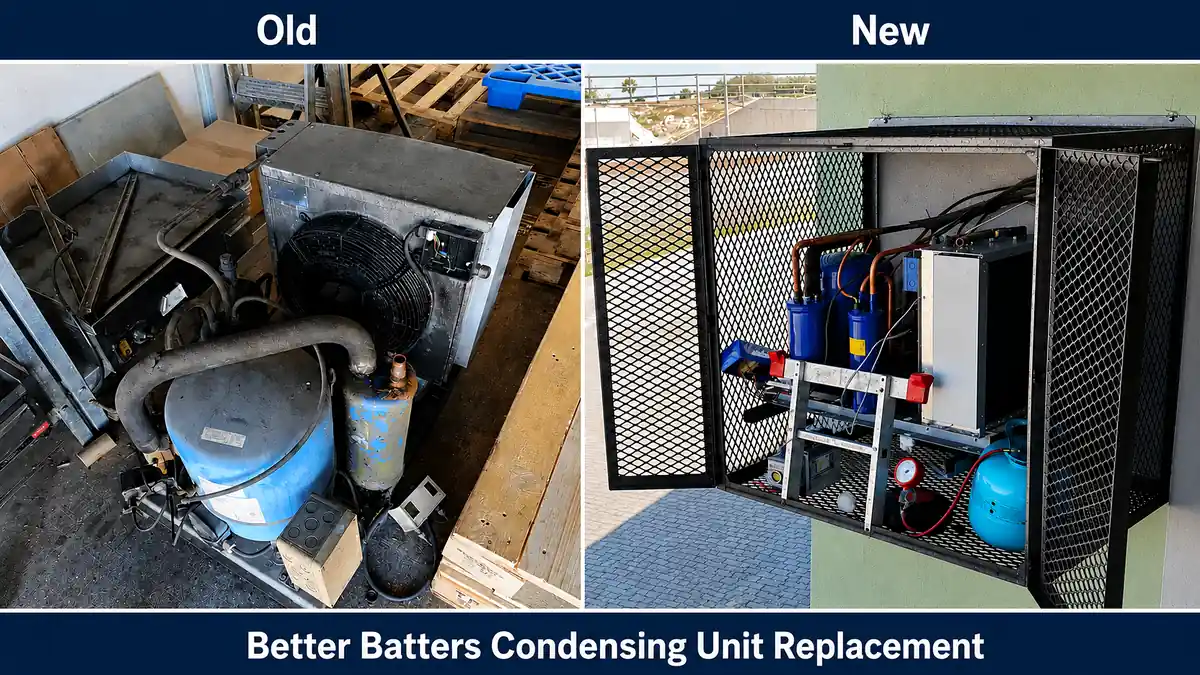
8. Dirty Condenser Coil
Dust, grease, flour and fibres form an insulating layer on condenser fins.
The system must then operate at a higher condensing pressure to reject the same amount of heat.
This increases compressor demand and can reduce cooling capacity.
Condenser-cleaning frequency should be based on the environment:
- Clean plant area: less frequent
- Commercial kitchen: more frequent
- Bakery or flour environment: substantially more frequent
- Coastal location: cleaning plus corrosion inspection
- Outdoor unit near vegetation: regular debris removal
A maintenance schedule based only on calendar intervals may not be sufficient in a heavily contaminated environment.
9. Refrigeration-System Sizing
An energy-efficient system must be correctly matched to the room load.
Danfoss states that properly sized and designed refrigeration equipment has a major influence on walk-in cooler and freezer performance. The compressor, condenser, metering device, evaporator and controls must function as a compatible system.
An undersized system
An undersized system may:
- Run continuously
- Recover slowly after deliveries
- Fail to reach temperature
- Operate at stressful conditions
- Consume large amounts of electricity while still performing poorly
An oversized system
An oversized system may:
- Start and stop too frequently
- Control temperature unevenly
- Fail to manage humidity properly
- Operate inefficiently at low load
- Cause unnecessary electrical demand
- Wear contactors and compressor components
Equipment should be selected using a refrigeration load calculation rather than room dimensions alone.
The calculation should include:
- Panel heat gain
- Door infiltration
- Product load
- People
- Fans
- Lighting
- Defrost
- Maximum ambient temperature
- Required pull-down time
10. Component Compatibility
Efficient refrigeration depends on the compatibility of:
- Compressor
- Condenser
- Evaporator
- Expansion valve
- Refrigerant
- Receiver
- Pipe sizing
- Controllers
- Fans
- Defrost equipment
A high-efficiency compressor cannot deliver its intended performance when paired with:
- An undersized condenser
- A restricted liquid line
- Incorrect expansion valve
- Poor evaporator airflow
- Wrong refrigerant charge
- Excessive pipe pressure drop
- Incorrect control settings
The complete refrigeration circuit should be designed as one system.
Copeland describes a condensing unit as a coordinated package in which the compressor moves refrigerant and the condenser and fans reject the absorbed heat. Efficient heat rejection is therefore inseparable from compressor performance.
11. Equipment Efficiency
Compressors and fan motors do not all provide the same efficiency.
Possible efficiency improvements include:
- Correctly selected scroll or reciprocating compressors
- Variable-capacity compressors
- Variable-speed condenser fans
- Electronically commutated fan motors
- Efficient evaporator coils
- Properly selected expansion valves
- Floating condensing-pressure control
- Demand-based control
- LED lighting
Variable-capacity systems can match output more closely to changing refrigeration load instead of repeatedly cycling at full capacity.
However, advanced equipment does not guarantee savings where:
- The room is poorly insulated
- Doors remain open
- The condenser is dirty
- Sensors are inaccurate
- Controls are incorrectly configured
The design should prioritise the largest sources of energy loss first.
12. Product Load
Products entering the room introduce heat.
The amount depends on:
- Product mass
- Product type
- Entry temperature
- Required storage temperature
- Water content
- Packaging
- Loading rate
- Required pull-down time
A holding cold room receiving pre-chilled products has a smaller product load than a room receiving the same stock at room temperature.
For example, chilling 500kg of produce from 22°C to 5°C requires substantially more refrigeration work than holding 500kg that already enters at 5°C.
The refrigeration system then operates for longer after delivery, increasing electricity consumption.
Reduce unnecessary product load by:
- Pre-cooling products where practical
- Maintaining the delivery cold chain
- Avoiding leaving chilled stock in warm loading areas
- Loading in controlled batches
- Avoiding simultaneous loading of excessive warm product
- Specifying the system for the actual daily load
A cold room designed only for storage should not be expected to perform as a rapid pull-down chiller.
13. Stock Arrangement and Airflow
Cold air must travel from the evaporator, pass around the products and return to the evaporator.
Poor airflow can make the compressor run longer while some products remain too warm.
Common airflow problems include:
- Stock packed against the evaporator
- Return-air path blocked
- Shelves filled without circulation gaps
- Products stacked to the ceiling
- Plastic packaging covering air passages
- Room overloaded
- Failed evaporator fan
- Ice blocking the coil
A well-arranged room may maintain more uniform conditions at a higher and more efficient setpoint than an overcrowded room with warm areas.
Do not reduce aisle and airflow space simply to maximise the number of boxes inside the room.
14. Evaporator and Condenser Fan Energy
Fan motors consume electricity and introduce heat.
The evaporator fans are located inside the cold room, so most of their motor heat becomes part of the refrigeration load.
Fan-energy improvements may include:
- Efficient fan motors
- Correct fan selection
- Fan-speed control
- Switching fans off during suitable periods
- Correct fan-delay settings after defrost
- Cleaning fan blades
- Replacing damaged blades
- Maintaining clean evaporator coils
Fan controls must not compromise product temperature or cause uneven air distribution.
15. Ice on the Evaporator
Ice restricts airflow and insulates the evaporator coil.
The compressor and fans may then operate for longer while transferring less heat.
Ice can result from:
- Incorrect defrost settings
- Failed heaters
- Failed defrost sensor
- Door left open
- Damaged gasket
- Excessive humidity
- Blocked drain
- Fan problems
- Refrigerant-feed faults
The correct response is not simply to increase the number or duration of defrost cycles.
Unnecessary defrost introduces additional heat that the refrigeration system must later remove.
Danfoss explains that humidity, airflow, overfilling and open doors can change the amount of frost formed, which is why demand-based or adaptive defrost can be more efficient than a rigid schedule in suitable systems.
16. Defrost Energy
Positive-temperature cold rooms may sometimes use off-cycle defrost, depending on the evaporator operating conditions.
Freezer rooms commonly require active defrost using:
- Electric heaters
- Hot gas
- Other specialised methods
Electric defrost heaters can represent a significant load.
Energy is wasted when:
- Defrost occurs more frequently than necessary
- Heaters remain active after the coil is clear
- Defrost termination sensors are faulty
- Fans restart too early
- Drain heaters operate unnecessarily
- The door introduces excessive moisture
A properly configured controller should coordinate:
- Defrost start
- Defrost termination
- Drip time
- Compressor operation
- Fan delay
- Drain heating
17. Temperature-Controller Settings
A controller that is set lower than required increases electricity consumption.
Other inefficient control conditions include:
- Differential too narrow
- Compressor cycling too frequently
- Incorrect sensor offset
- Defrost scheduled too often
- Fans running unnecessarily
- Door heaters operating continuously
- Lights left on
- Crankcase heaters not controlled correctly
Modern controllers can coordinate temperature, defrost, fans, doors, lights and heaters. Danfoss reports that integrated controller functions can support meaningful efficiency improvements where correctly applied and commissioned.
Controller changes should be documented. Staff should not experiment with technical parameters to correct an unrelated mechanical fault.
18. Temperature Sensor Position
A badly positioned sensor can cause overcooling or undercooling.
Problems occur when the probe is:
- Directly in cold discharge air
- Too close to the door
- Against a wall
- Beside warm lights
- Buried in stock
- Near an air leak
- Loose or damaged
If the sensor reads warmer than the representative room condition, the compressor may run longer than necessary.
If it reads colder, the system may switch off before products are adequately cooled.
Sensor accuracy and position should be checked during commissioning and maintenance.
19. Refrigerant Charge and System Condition
Both insufficient and excessive refrigerant can reduce efficiency.
Insufficient charge
Possible effects include:
- Reduced evaporator feeding
- Long runtime
- Poor cooling
- High compressor temperature
- Reduced capacity
Excessive charge
Possible effects include:
- High condensing pressure
- Increased compressor load
- Reduced condenser effectiveness
- Risk of liquid-related problems
The correct charge must be confirmed using the manufacturer’s method and appropriate pressure and temperature measurements.
Refrigerant should not require regular topping up. Repeatedly low charge normally indicates a leak or an unresolved servicing problem.
20. Refrigeration Pipework
Poor pipe design can increase energy use.
Problems include:
- Pipe diameter too small
- Excessive pipe length
- Unnecessary bends
- Poor suction-line insulation
- Damaged insulation
- Incorrect pipe routing
- Excessive vertical lift
- Oil trapping
- Pressure loss
Commercial refrigeration guidance recommends avoiding excessive pipe lengths and ensuring refrigeration pipework is correctly insulated and routed.
The condenser and evaporator should not be separated by a long, difficult route without accounting for the effect on refrigerant flow and system capacity.
21. Maintenance Condition
A well-designed cold room can become inefficient when maintenance is neglected.
Energy-related maintenance checks include:
- Condenser cleaning
- Evaporator cleaning
- Fan operation
- Door-seal inspection
- Controller accuracy
- Defrost testing
- Refrigerant leak checks
- Electrical inspection
- Compressor-pressure assessment
- Pipe-insulation repair
- Panel-joint inspection
- Drain cleaning
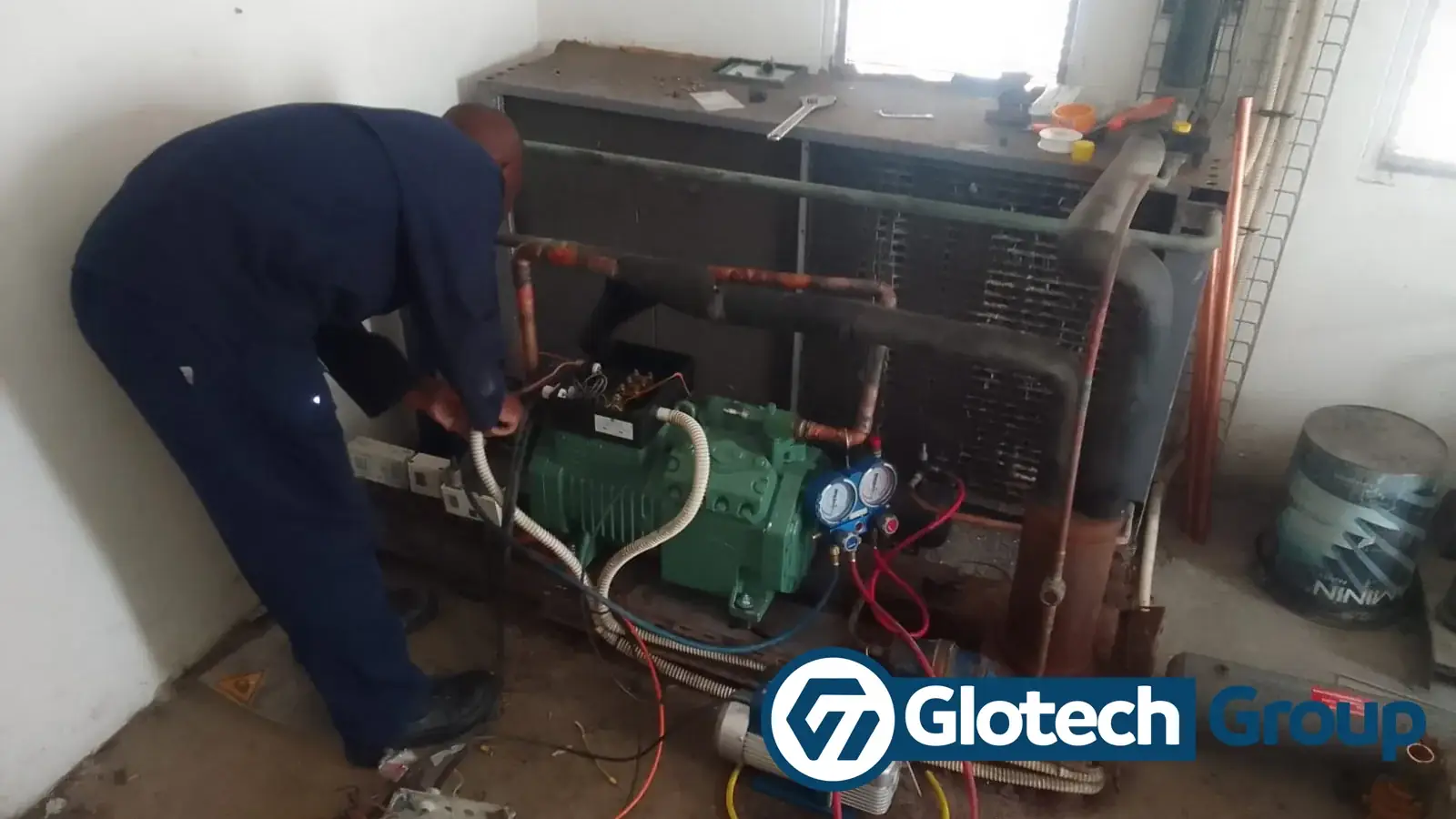
Glotech Group’s repair and maintenance page identifies blocked condensers, refrigerant leaks, iced evaporators, damaged seals, failed fans and incorrect controls as common faults affecting cold-room performance.
A gradual increase in energy consumption can be an early warning of a developing fault even before the room loses temperature completely.
How to Reduce Cold Room Electricity Use
1. Measure Before Making Changes
Install a submeter or gather reliable runtime data.
Record:
- Daily kWh
- Room temperature
- Ambient temperature
- Product deliveries
- Door activity
- Defrost times
- Maintenance work
Without a baseline, it is difficult to prove whether an upgrade produced savings.
2. Keep the Condenser Clean
Create a cleaning interval based on actual contamination.
A kitchen or bakery unit may require more frequent cleaning than a condenser in a clean equipment room.
3. Improve Condenser Ventilation
Remove obstructions and prevent discharged hot air from returning to the coil.
Where necessary, relocate the unit or improve mechanical ventilation.
4. Repair Door Seals Promptly
Inspect gaskets, hinges, rollers, thresholds and latches.
A small continuous opening can add heat and moisture throughout the day.
5. Reduce Door-Open Time
Train staff to prepare loads before opening the room.
Consider:
- Strip curtains
- Self-closing hardware
- Door alarms
- Fast-action doors
- Better stock organisation
6. Maintain Airflow
Keep stock away from the evaporator and preserve return-air paths.
Do not stack products directly against walls or to the ceiling.
7. Use the Correct Setpoint
Store each product at its required temperature without unnecessarily reducing the setpoint.
Any change must remain within food-safety, quality or regulatory limits.
8. Optimise Defrost
Inspect the reason for repeated ice formation before increasing defrost frequency.
Use suitable demand-based or adaptive controls where justified.
9. Replace Inefficient Lighting
Use suitable LED fittings and ensure lights switch off when the room is unoccupied.
Lighting energy is consumed twice:
- By the light itself
- By the refrigeration system removing the light’s heat
10. Pre-Cool Products Where Practical
Maintain the cold chain so the cold room receives stock close to its storage temperature.
Do not use a holding room as a substitute for a blast chiller or blast freezer.
11. Service the Refrigeration System
A professional service should assess:
- Pressures
- Temperatures
- Electrical current
- Condenser condition
- Evaporator airflow
- Refrigerant charge
- Controls
- Fans
- Door seals
- Defrost
- Overall capacity
12. Repair Damaged Insulation
Seal panel joints, pipe penetrations and damaged door frames.
Replace wet or structurally damaged panels where resealing alone will not restore performance.
13. Use Monitoring and Alarms
Connected controls can track:
- Temperature
- Door openings
- Compressor runtime
- Defrost
- Alarms
- Energy consumption
Danfoss notes that connected controls can support performance trending, food-safety reporting, predictive maintenance and energy optimisation.
14. Consider Equipment Upgrades Carefully
Older equipment may benefit from:
- Efficient compressor replacement
- EC fan motors
- Variable-speed control
- Electronic expansion valves
- Improved condenser
- Modern controller
- Better monitoring
Calculate the likely saving against:
- Equipment cost
- Installation cost
- Remaining system life
- Refrigerant compatibility
- Maintenance condition
- Expected annual operating hours
Do not replace efficient working equipment solely because a newer component has a higher published efficiency. The business case should be based on measured consumption and the complete system.
How to Investigate a Sudden Increase in Electricity Use
A sudden increase may indicate:
- Dirty condenser
- Failed condenser fan
- Refrigerant leak
- Evaporator icing
- Damaged door gasket
- Door being left open
- Controller setpoint changed
- Defrost heater operating excessively
- Sensor fault
- Warm product load increased
- Ambient temperature increased
- Compressor mechanical problem
- Lighting left on
- Panel damage
- Change in electricity tariff
- Change in billing period or estimated meter reading
Review both the refrigeration system and the electricity account.
A higher bill does not always mean the cold room consumed more kWh. The tariff, demand charge, billing period or fixed charges may have changed.
Compare:
- kWh consumed
- Maximum demand
- Number of billing days
- Energy rate
- Fixed charges
- Seasonal or time-of-use charges
How to Compare an Old and New Cold Room
When evaluating a proposed energy-efficient installation, compare the rooms under equivalent conditions.
Record:
- Internal dimensions
- Temperature
- Product load
- Ambient temperature
- Door usage
- Insulation U-value
- Equipment capacity
- Refrigerant
- Compressor type
- Fan power
- Defrost method
- Measured annual kWh
Do not compare only compressor horsepower.
A smaller motor operating continuously can use more electricity than a larger, more efficient system that satisfies the load and cycles correctly.
Frequently Asked Questions
How much electricity does a cold room use per day?
There is no standard daily figure. Consumption depends on refrigeration capacity, compressor runtime, fans, heaters, temperature, room size, product loading and ambient conditions. Measure the room with a submeter or calculate each electrical load using its actual operating hours.
How do I calculate cold room electricity cost?
Calculate the kWh used by the compressor, fans, heaters, lights and controls, then multiply the total by the applicable tariff. Use the tariff shown on the business’s electricity account because South African charges vary by supplier and customer category.
Does a cold room compressor run continuously?
A correctly designed system normally cycles or varies its capacity according to the load. Continuous operation may occur during pull-down or very high demand, but persistent continuous running can indicate insufficient capacity, high heat gain, dirty coils, refrigerant problems or incorrect settings.
Does a freezer room use more electricity than a cold room?
Usually. A freezer maintains a lower temperature, operates at a greater temperature difference and normally requires active defrost and additional heaters.
Do thicker panels reduce electricity use?
Better insulation reduces heat entering through the room envelope. The benefit depends on panel material, thickness, U-value, room size, temperature difference and installation quality.
Can a damaged door seal increase electricity consumption?
Yes. A damaged seal allows warm and humid air to enter continuously, increasing refrigeration and defrost loads.
Does opening the cold room door use a lot of electricity?
Frequent or prolonged opening can create a substantial load, especially in humid conditions and freezer rooms. Door management is one of the most practical operating improvements.
Can a dirty condenser increase the electricity bill?
Yes. A blocked condenser rejects heat less effectively, increasing condensing pressure and compressor workload.
Should I switch the cold room off overnight?
Normally not when temperature-sensitive stock remains inside. Switching off can compromise product temperature and may require additional energy for recovery. Control strategies should be designed around product safety and operating conditions.
Does setting the thermostat colder cool products faster?
Not necessarily. The refrigeration system’s capacity determines its cooling rate. A lower setpoint may simply cause longer operation and possible product damage.
Can solar power run a cold room?
Solar can offset refrigeration electricity use, but the system must account for daytime and overnight loads, compressor starting demand, batteries, inverter capacity, seasonal conditions and backup requirements. Begin with measured cold room consumption before sizing a solar system.
Is an inverter refrigeration unit always more efficient?
Variable-speed technology can improve part-load efficiency when properly selected and controlled. It is not automatically the best solution for every room, particularly if the enclosure, condenser location or product-loading practices remain inefficient.
How often should an energy assessment be completed?
Review consumption monthly and investigate unexplained changes. A more detailed assessment is appropriate when bills rise, room usage changes, equipment becomes unreliable or a major repair or replacement is being considered.
Reduce the Refrigeration Load Before Increasing the Equipment Size
Cold room electricity consumption is not determined by room dimensions alone.
The largest influences are often:
- Required temperature
- Insulation performance
- Door usage
- Ambient heat
- Condenser ventilation
- Product entry temperature
- Equipment sizing
- Component efficiency
- Controller and defrost settings
- Maintenance condition
Businesses should first identify where heat is entering and why the refrigeration system is running.
In many cases, cleaning a condenser, repairing a door seal, correcting airflow or adjusting an unsuitable defrost programme can reduce unnecessary runtime without replacing the complete system.
Where a room was incorrectly designed, has insufficient insulation or no longer matches the business’s product load, a larger repair or system upgrade may be required.
Glotech Group provides inspections, planned maintenance and fault diagnosis for inefficient or continuously running commercial refrigeration systems. Visit the commercial cold-room repairs and maintenance page for assistance with condenser problems, refrigerant faults, door seals, controls and compressor performance.
Businesses planning a new energy-efficient room can learn more about system sizing, insulated enclosures and complete cold room installations in the Western Cape.