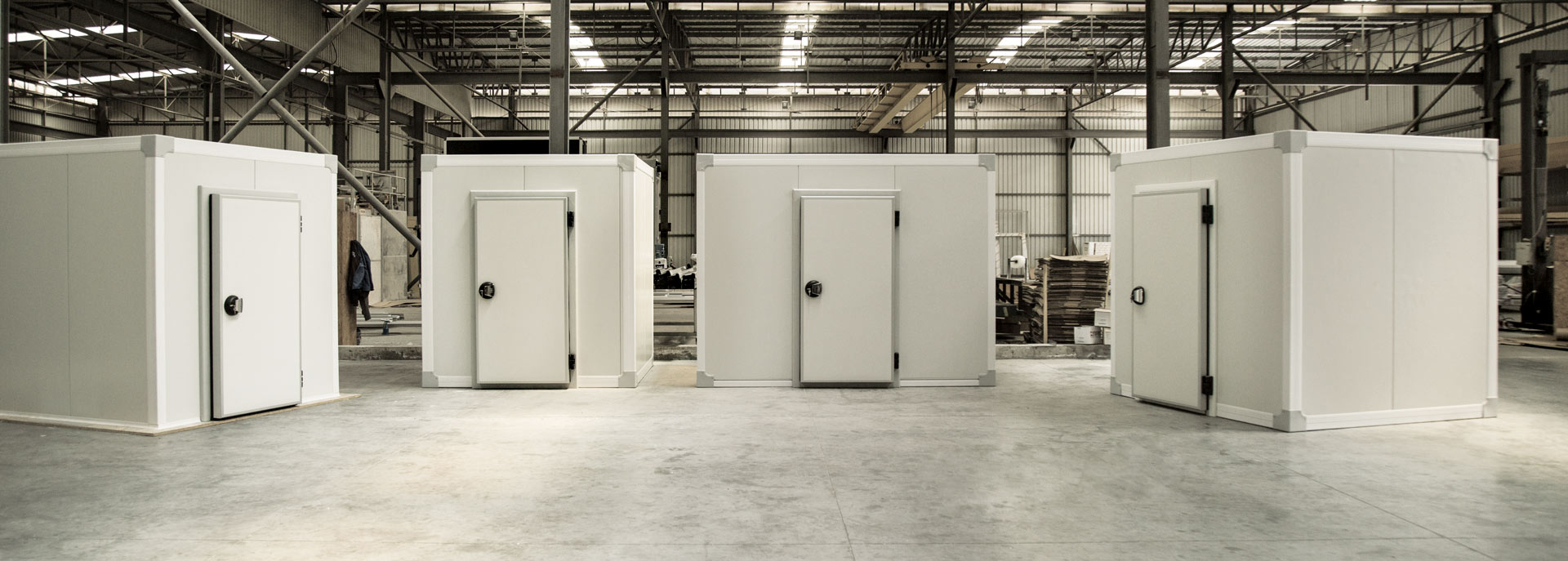
Choosing the correct insulated panel thickness is an important part of designing a cold room, freezer room or temperature-controlled workspace.
A thicker panel generally provides greater resistance to heat transfer, but thickness alone does not determine whether a panel is suitable. The correct specification also depends on:
- The required internal temperature
- The temperature outside the room
- Whether the room is chilled or frozen
- The panel’s insulation material
- Exposure to direct sunlight
- Room dimensions
- Wall and ceiling spans
- Structural loading
- Joint design and sealing
- Door usage
- Moisture and vapour control
- Fire-performance requirements
- Expected operating life
A 100mm polyurethane panel and a 100mm expanded-polystyrene panel do not necessarily provide the same thermal performance. Similarly, a correctly installed 100mm panel system may perform better than a poorly sealed 150mm enclosure.
This guide explains the typical applications for 50mm, 100mm, 125mm and 150mm insulated panels, the factors that influence panel selection and why a project should be specified according to its complete operating conditions rather than thickness alone.
Insulated Panel Thickness Comparison
The following table provides a broad planning overview. It is not a substitute for a project-specific thermal, structural and fire assessment.
| Panel thickness | Typical applications | General considerations |
|---|---|---|
| 50mm | Internal partitions, food-processing rooms, moderate-temperature spaces and selected mild chilled applications | Compact and economical, but may be unsuitable for demanding cold storage |
| 100mm | Many commercial cold rooms, chillers and selected freezer applications | Common balance between insulation, cost and usable internal space |
| 125mm | Lower-temperature rooms, demanding chillers, freezer rooms and high-ambient applications | Greater thermal resistance and additional margin against heat gain |
| 150mm | Freezer rooms, low-temperature storage, high-ambient sites and demanding temperature-controlled facilities | Stronger insulation, but greater cost, weight and loss of internal space |
These applications overlap because the insulation core matters. Industry guidance notes that polyurethane panels can provide similar thermal performance at a lower thickness than expanded-polystyrene panels. Cold Link Africa gives the example that approximately 60mm of polyurethane may provide thermal properties comparable to 100mm of polystyrene, while 100mm polyurethane may replace approximately 150mm polystyrene in some comparisons.
The panel manufacturer’s certified thermal data should therefore be checked before approving a thickness.
What Does Panel Thickness Actually Control?
An insulated sandwich panel normally consists of:
- An external metal facing
- An insulation core
- An internal metal facing
- An interlocking joint system
The insulation slows heat transfer through the wall or ceiling. As the insulation becomes thicker, the panel generally achieves a lower thermal transmittance, or U-value.
A lower U-value means less heat passes through a square metre of the enclosure for a given temperature difference.
Manufacturer data illustrates the relationship. One current cold-store panel range lists progressively lower U-values as thickness increases from 50mm through 100mm, 125mm and 150mm. The precise values apply only to that specific product, but the pattern demonstrates why greater thickness normally improves thermal resistance.
Panel thickness can affect:
- Heat entering a cold room
- Refrigeration compressor runtime
- Temperature stability
- Condensation risk
- Exterior surface temperature
- Required refrigeration capacity
- Internal floor area
- Structural spans
- Panel weight
- Installation cost
The objective is not simply to select the thickest panel available. It is to meet the required thermal, structural, hygiene and fire performance without unnecessary cost or loss of usable space.
Why Temperature Difference Matters
Panel selection should be based on the difference between the room temperature and the surrounding temperature.
This is often called the temperature differential.
Consider an installation where the area outside the room reaches 32°C:
Chilled room at +5°C
32°C − 5°C = 27°C temperature difference
Freezer room at −18°C
32°C − (−18°C) = 50°C temperature difference
The freezer enclosure must resist almost twice the temperature difference in this simplified example.
That greater difference normally increases:
- Heat transfer through the panels
- Refrigeration load
- Risk of condensation
- Moisture movement through weak joints
- Dependence on correct vapour sealing
- Required insulation thickness
This is why the same panels should not automatically be used for both a moderate-temperature processing room and a −18°C freezer.
50mm Insulated Panels
Typical applications
A 50mm insulated panel may be suitable for:
- Internal temperature-controlled partitions
- Food-preparation rooms
- Clean processing areas
- Packaging rooms
- Temperature-stable workspaces
- Moderate-temperature storage
- Selected beverage rooms
- Short-term chilled holding under mild conditions
- Enclosures where the temperature difference is relatively small
It can also be used for non-refrigerated buildings where the main objective is moderate thermal separation, hygiene or rapid partition construction.
Advantages of 50mm panels
- Lower initial material cost
- Lower panel weight
- Easier handling
- Reduced loss of internal space
- Suitable for many non-freezer partitions
- Faster modification in selected modular installations
Limitations of 50mm panels
A 50mm panel may provide insufficient thermal resistance where:
- The room operates near 0°C
- The room is a freezer
- Exterior temperatures are high
- Walls or roofs receive direct sunlight
- The refrigeration system operates continuously
- Energy efficiency is a high priority
- Door traffic is heavy
- The insulation core has relatively high thermal conductivity
Although some panel manufacturers offer 50mm cold-store products, availability does not mean that the thickness is suitable for every cold-room application. Kingspan, for example, offers cold-store panel ranges in multiple thicknesses from 50mm upward so that the system can be matched to different thermal and structural requirements.
When should you avoid 50mm panels?
Do not select 50mm panels for a freezer room merely because they are cheaper or already available.
For low-temperature applications, inadequate insulation can result in:
- Excessive heat gain
- Long compressor running times
- Difficulty maintaining temperature
- Condensation on external surfaces
- Ice around joints
- Greater electricity consumption
- Premature refrigeration-system wear
A 50mm panel should be approved only after considering the core material, certified U-value, ambient temperature and required room temperature.
100mm Insulated Panels
Typical applications
A 100mm insulated panel is commonly considered for:
- Commercial cold rooms
- Restaurant cold rooms
- Chilled ingredient rooms
- Fresh-produce rooms
- Dairy storage
- Meat chilling rooms
- Beverage storage
- Food-production facilities
- Selected freezer rooms
- Internal and external temperature-controlled enclosures
It often provides a practical balance between thermal resistance, material cost and usable room dimensions.
Why are 100mm panels common?
Cold rooms usually operate with a larger temperature difference than ordinary insulated buildings. A 100mm panel can provide a more substantial thermal barrier than a 50mm panel without consuming as much space as a 125mm or 150mm system.
However, the phrase 100mm insulated panel is not a complete specification.
A quotation should also identify:
- EPS, PU, PUR or PIR insulation core
- Core density
- Declared thermal conductivity
- Certified U-value
- Metal-facing thickness
- Joint design
- Surface coating
- Fire classification
- Maximum permitted span
- Internal and external finish
A South African industry source notes that panel selection should account for both the insulation material and thickness because different cores can provide different thermal performance at the same nominal thickness.
Are 100mm panels suitable for a cold room?
They are frequently suitable for positive-temperature cold rooms, but the final decision depends on:
- Internal setpoint
- Local summer conditions
- Indoor or outdoor location
- Product load
- Door usage
- Ceiling exposure
- Room size
- Refrigeration operating hours
A cold room inside a shaded warehouse may have less envelope heat gain than an identical room installed outdoors in direct Cape summer sunlight.
Are 100mm panels suitable for a freezer room?
Possibly, but not automatically.
Some technical guides place 100mm panels within the range used for ordinary commercial freezer rooms, particularly where the insulation core has strong thermal performance and the installation is indoors. Other projects require 125mm or 150mm panels because of lower temperatures, high ambient heat or stricter efficiency requirements.
The floor, door and ceiling must also meet the freezer specification. Using 100mm wall panels does not make an enclosure freezer-ready where the floor is uninsulated or the joints are poorly sealed.
125mm Insulated Panels
Typical applications
A 125mm insulated panel may be considered for:
- Commercial freezer rooms
- Low-temperature cold storage
- Chilled rooms in high-ambient locations
- Rooms exposed to long operating hours
- Energy-sensitive refrigeration projects
- Large rooms with significant external surface area
- Temperature-controlled production facilities
- Roof and ceiling applications requiring stronger thermal performance
- Projects where 100mm provides insufficient design margin
Why choose 125mm instead of 100mm?
The additional thickness reduces heat transfer through the panel, assuming the same insulation core and construction.
This can help with:
- Lower envelope heat gain
- Improved temperature stability
- Reduced refrigeration load
- Lower external condensation risk
- Better performance during hot weather
- Improved recovery after loading
- Greater protection against future operating changes
A 125mm panel can be a useful intermediate option where 100mm is marginal but 150mm is not necessary.
Cold-store panel manufacturers commonly include 125mm as a standard thickness because many projects fall between ordinary chilled-room and demanding low-temperature requirements.
When might 125mm panels be appropriate?
Possible examples include:
- A freezer operating near −18°C inside a warm production building
- A cold room exposed to high external temperatures
- A large ceiling with significant heat gain from a roof above
- A facility where refrigeration energy is a major operating cost
- A room expected to operate continuously for many years
- An installation where the existing refrigeration capacity has limited spare margin
These examples remain subject to thermal and structural calculations.
Space implications
Increasing panel thickness reduces the internal dimensions where the external footprint stays unchanged.
For example, changing both opposing walls from 100mm to 125mm reduces internal width by an additional 50mm overall:
25mm extra on one side + 25mm extra on the opposite side = 50mm
The loss may appear small, but it can affect:
- Shelf depth
- Pallet clearances
- Door openings
- Aisle widths
- Evaporator placement
- Existing building columns
Panel thickness should therefore be incorporated into the layout before the room is manufactured.
150mm Insulated Panels
Typical applications
A 150mm insulated panel is commonly considered for:
- Commercial freezer rooms
- Low-temperature frozen storage
- Pull-down freezer applications
- Ice-cream storage
- Frozen meat and seafood storage
- High-ambient installations
- Outdoor freezer rooms
- Large refrigerated warehouses
- Temperature-critical industrial applications
- Facilities seeking stronger long-term thermal performance
It may also be used where the chosen insulation material requires greater thickness to achieve the required U-value.
Why are 150mm panels used for freezers?
A freezer room has a much greater temperature difference between its interior and surroundings than a typical chilled room.
Increasing insulation thickness helps reduce the continuous flow of heat into the freezer. This can improve:
- Temperature stability
- Refrigeration-system efficiency
- Compressor duty
- Recovery after door openings
- Resistance to external condensation
- Long-term energy performance
Industry guides often place 150mm panels within the range used for demanding freezer, deep-freeze or high-temperature-differential applications.
However, the exact temperature capability depends strongly on the core. It would be misleading to state that every 150mm panel is suitable for every freezer.
When might 150mm panels be unnecessary?
They may be excessive for:
- A moderate processing room
- A small positive-temperature cold room inside an air-conditioned building
- A low-duty chilled enclosure
- A partition requiring hygiene rather than strong refrigeration insulation
Unnecessary thickness can increase:
- Material cost
- Transport cost
- Door cost
- Room weight
- Structural requirements
- Loss of internal floor area
- Installation difficulty
The correct choice is the thickness that meets the design requirements with appropriate safety and efficiency margins.
Cold Room Panel Thickness Guide
The following ranges can be used as an initial discussion guide only.
| Application | Possible panel range | Important qualification |
| Food-processing partition | 50–100mm | Depends on required room temperature and hygiene specification |
| Moderate chilled room | 50–100mm | 50mm should be used only where thermal conditions support it |
| Commercial cold room | 100–125mm | Core material, ambient temperature and location remain important |
| Standard frozen-storage room | 100–150mm | Floor, door, vapour sealing and defrost must also be freezer rated |
| High-ambient freezer | 125–150mm or more | Requires project-specific thermal calculation |
| Deep-freeze or specialised low-temperature room | 150mm or more | Equipment and enclosure must be engineered together |
Published guides vary because they assume different insulation materials, ambient conditions and products. Some suggest approximately 50–75mm for mild chillers, 100–120mm for ordinary freezers and 150mm or more for more demanding low-temperature applications. Others start their recommended chilled-room range closer to 75–100mm.
This variation is exactly why thickness should not be chosen from a generic chart alone.
Freezer Room Panel Thickness
A freezer room normally requires more insulation than a positive-temperature cold room.
The proposed freezer panel thickness should be selected after determining:
- Required room temperature
- Maximum ambient temperature
- Indoor or outdoor position
- Product entry temperature
- Daily product load
- Door-opening frequency
- Required pull-down time
- Refrigeration capacity
- Floor construction
- Ceiling exposure
- Insulation core
- Expected electricity cost
- Required service life
For ordinary frozen storage near −18°C, 100mm, 125mm and 150mm panels may all appear in proposals.
The correct choice depends on the complete assembly.
For example:
- A high-performance 100mm PU or PIR panel inside a controlled warehouse may be technically suitable for a particular freezer.
- A 100mm EPS panel exposed to high ambient heat may provide insufficient thermal resistance for the same operating conditions.
- A 150mm panel may be selected where energy efficiency, direct sunlight or lower temperatures create a more demanding requirement.
Panel thickness should not be evaluated separately from the floor. A freezer with well-insulated walls but an uninsulated floor can still experience excessive heat gain and possible frost-related structural problems.
The Insulation Material Changes the Answer
The most common insulated panel cores include:
- Expanded polystyrene, or EPS
- Polyurethane, or PU/PUR
- Polyisocyanurate, or PIR
- Mineral wool or rock wool for selected fire-performance applications
Expanded polystyrene panels
EPS panels are widely used because they can offer:
- Competitive material cost
- Low weight
- Availability in multiple thicknesses
- Practical modular construction
- Suitable thermal performance when correctly specified
EPS generally requires greater thickness than PU or PIR to achieve similar thermal resistance.
Polyurethane panels
PU panels commonly provide:
- Low thermal conductivity
- Strong thermal performance at reduced thickness
- Closed-cell construction
- Good suitability for refrigerated spaces
- More usable internal space where dimensions are restricted
PIR panels
PIR is related to polyurethane but is formulated to provide different fire and thermal characteristics.
The exact performance varies by product, manufacturing process and certification. The term “PIR” alone does not prove that a panel complies with the fire, insurance or building requirements of a specific project.
Mineral-wool panels
Mineral wool may be selected where fire resistance is a primary concern. Its thermal and moisture characteristics differ from foam-core panels, so thickness should be determined from the tested panel system rather than compared directly by millimetres.
Why U-Value Is More Useful Than Thickness Alone
Panel thickness is easy to understand, but U-value provides a better indication of thermal performance.
The U-value measures the rate of heat transfer through an assembly.
A lower U-value indicates greater resistance to heat transfer.
For a simplified panel heat-gain estimate:
Heat transfer = panel area × U-value × temperature difference
Suppose two panels enclose the same room:
Panel A
- Area: 100m²
- U-value: 0.35 W/m²K
- Temperature difference: 40°C
100 × 0.35 × 40 = 1,400 watts
Panel B
- Area: 100m²
- U-value: 0.18 W/m²K
- Temperature difference: 40°C
100 × 0.18 × 40 = 720 watts
In this simplified comparison, Panel B allows substantially less continuous heat transfer through the enclosure.
Actual cold-room load calculations must also include:
- Air infiltration
- Product load
- People
- Lighting
- fans
- Door openings
- defrost
- floor heat gain
- thermal bridges
The example shows why certified U-value matters more than a thickness label by itself.
Room Location Can Change the Required Thickness
Two identical cold rooms can need different panel specifications when installed in different locations.
Indoor installation
A room inside a warehouse may be protected from:
- Direct solar radiation
- Rain
- Wind
- Extreme daily temperature changes
This can reduce the maximum temperature surrounding the panels.
Outdoor installation
An outdoor room may experience:
- Direct sunlight
- High roof temperatures
- Rain exposure
- Wind pressure
- Coastal corrosion
- Greater temperature variation
- More difficult joint sealing
- Structural weather loads
A technical panel guide advises allowing additional insulation where walls and roofs are exposed to direct sunlight, illustrating the importance of solar exposure in thickness selection.
For an outdoor room, the design may also require:
- Weatherproof roofing
- Suitable external coatings
- Flashings
- Structural framing
- Rainwater management
- UV-resistant sealants
- Wind-load calculations
- Corrosion protection
The panel thickness cannot address these requirements by itself.
Walls, Ceilings and Floors May Need Different Specifications
Not every surface of a room must automatically use the same panel.
The designer may specify different constructions for:
- Walls
- Ceiling
- Roof
- Floor
- Internal partitions
Ceiling panels
The ceiling may experience greater heat gain where it is located beneath a hot roof or exposed directly to sunlight.
It must also support:
- Its own weight
- Lighting
- Suspended services where permitted
- Maintenance loads only where specifically designed
- Pressure differences
- Required span between supports
A panel selected for wall thermal performance may not have sufficient structural capacity for a long unsupported ceiling span.
Floor panels
Floor panels must withstand:
- Shelving loads
- Trolleys
- Pallets
- Racking
- Foot traffic
- Forklift loads
- Concentrated wheel loads
A standard wall panel should not automatically be used as a loaded floor.
Freezer floors also require continuous insulation and vapour control. Ground-bearing applications may require frost-heave prevention.
Structural Performance Matters
Increasing panel thickness can improve stiffness, but structural performance depends on more than the insulation core.
Important variables include:
- Panel thickness
- Metal-facing thickness
- Steel grade
- Profile shape
- Core adhesion
- Span
- Support spacing
- Wind pressure
- Ceiling loads
- Internal pressure
- Door openings
- Suspended equipment
- Fire exposure
A long ceiling span may require thicker panels or additional structural supports even where a thinner panel would provide adequate thermal insulation.
Similarly, an external panel exposed to wind may need a different support arrangement from an internal cold-room wall.
The installer should use the manufacturer’s span tables and loading data rather than assuming that thermal thickness automatically provides structural capacity.
Panel Joints and Sealing Are as Important as Thickness
Warm-air infiltration can undermine the performance of a thick panel system.
Common leakage locations include:
- Panel-to-panel joints
- Wall-to-floor junctions
- Wall-to-ceiling junctions
- Internal and external corners
- Door frames
- Refrigeration pipes
- Drain penetrations
- Electrical conduits
- Lighting penetrations
- Structural supports
- Damaged panel skins
Glotech Group’s cold-storage guidance identifies poor panel alignment, weak joints and low-quality installation as common causes of air leakage and increased refrigeration demand.
Warm air entering a freezer can introduce moisture that freezes inside joints, around doors or on the evaporator.
Possible consequences include:
- Condensation
- Ice formation
- Wet insulation
- Mould
- Corrosion
- Panel delamination
- Higher energy consumption
- Unstable temperatures
- Excessive defrost requirements
A continuous seal is therefore part of the thermal design.
Thermal Bridging
A thermal bridge is a path through the enclosure that conducts heat more readily than the surrounding insulation.
Possible thermal bridges include:
- Exposed steel supports
- Incorrect fasteners
- Uninsulated floor edges
- Door frames
- Panel joints
- Ceiling hangers
- Pipe penetrations
- Structural columns
Even where thick panels are used, poorly detailed metal connections can create local heat gain and condensation.
Modern insulated panel systems may use concealed fasteners, insulated joints or thermal breaks to reduce these effects. Metl-Span describes concealed fastening and joint arrangements designed to decrease thermal bridging and resist air and moisture movement.
Door Openings Can Reduce the Benefit of Thicker Panels
Panel heat gain occurs continuously, but open doors can introduce a large amount of warm, humid air in a short period.
A room with 150mm panels may still perform poorly when:
- The door remains open
- The gasket is damaged
- The door does not close correctly
- Staff block the doorway with stock
- The threshold is damaged
- No strip curtain is used in a high-traffic application
The enclosure should be treated as one system consisting of:
- Walls
- Ceiling
- Floor
- Door
- joints
- penetrations
- refrigeration equipment
- operating procedures
Thicker panels cannot compensate for uncontrolled door traffic.
How Panel Thickness Affects Refrigeration Capacity
Heat entering through the panels forms part of the refrigeration load.
A thicker, better-insulated enclosure can reduce the transmission load, potentially allowing:
- More stable temperatures
- Shorter compressor runtime
- Lower electrical consumption
- Improved performance during hot weather
- Additional capacity for product loading
- Reduced equipment wear
However, thicker panels do not eliminate other loads.
A refrigeration system must still account for:
- Warm products
- Frequent door openings
- Staff
- Lighting
- evaporator fans
- defrost heat
- air leakage
- external ventilation conditions
Do not reduce refrigeration capacity based solely on panel thickness without completing a proper heat-load calculation.
Cost Versus Long-Term Performance
Thinner panels generally reduce the initial material cost, but the lowest construction price may not provide the lowest lifetime cost.
A complete comparison should include:
- Panel purchase price
- Refrigeration equipment size
- Annual electricity consumption
- Compressor operating hours
- Maintenance
- Expected panel life
- Moisture risk
- Future room-temperature requirements
- Usable internal space
- Replacement difficulty
Thicker insulation can reduce ongoing heat gain, but the financial return depends on:
- Electricity tariffs
- Operating hours
- Temperature difference
- Room size
- Panel-core performance
- Installation quality
- Expected facility life
The optimum thickness is therefore an engineering and commercial decision.
Can You Add Insulation Later?
Increasing insulation after the room has been built is possible in some cases, but it is usually more complicated than selecting the correct system initially.
Retrofitting may require:
- Installing a second layer of panels
- Rebuilding doors and frames
- Extending refrigeration penetrations
- Modifying ceilings
- Moving electrical systems
- Replacing floor finishes
- Resealing vapour barriers
- Reducing internal room dimensions
Adding insulation externally may be difficult where walls are close to the building structure.
It is generally better to consider foreseeable future requirements during the original design.
Can Different Panel Thicknesses Be Combined?
Yes, provided the junctions, structural details and vapour seals are designed correctly.
Possible examples include:
- Thicker roof panels than wall panels
- Thicker freezer walls connected to a cold-room section
- A heavily insulated external wall with thinner internal partitions
- A thicker freezer floor
- Separate panels for an ante-room and freezer
The connection between different thicknesses must avoid:
- Steps that collect moisture
- Unsealed joints
- exposed insulation
- thermal bridges
- difficult-to-clean surfaces
- structural weakness
A split cold-room and freezer-room enclosure should be designed as a coordinated system rather than assembled from unrelated leftover panels.
Questions to Ask Before Choosing Panel Thickness
Before approving the specification, answer the following:
- What temperature must the room maintain?
- What is the highest expected ambient temperature?
- Is the room inside or outside?
- Will the roof or walls receive direct sunlight?
- What insulation core is being proposed?
- What is the panel’s certified U-value?
- What fire classification applies?
- What are the wall and ceiling spans?
- What loads will the floor carry?
- Is the room chilled or frozen?
- How frequently will the door open?
- What type of door will be installed?
- How will panel joints be sealed?
- How will pipe and cable penetrations be sealed?
- Does the quotation specify core density?
- Are internal and external finishes suitable?
- Is the floor included?
- Can the room be extended later?
A quotation stating only “100mm panels” does not provide enough information for a reliable comparison.
Information That Should Appear in a Panel Quotation
A detailed panel proposal should identify:
- Panel thickness
- Insulation material
- Core density
- Panel width
- Metal-facing material
- Metal-facing thickness
- Internal finish
- External finish
- Joint system
- Sealant or vapour-seal method
- Fire classification
- Structural support requirements
- Door specification
- Floor specification
- Ceiling support arrangement
- Flashings and trims
- Installation labour
- Delivery
- Exclusions
- Warranty
Where panels form part of a refrigerated room, the quotation should also state the intended operating temperature.
Common Panel-Selection Mistakes
Choosing according to thickness alone
Different insulation cores provide different thermal performance.
Using 50mm panels for a demanding cold room
The initial saving may result in excessive heat gain and refrigeration runtime.
Assuming every freezer needs exactly 150mm
Some freezer applications may be designed with 100mm or 125mm high-performance panels, while more demanding rooms may need 150mm or greater.
Ignoring ambient temperature
An indoor room and an outdoor sun-exposed room do not have the same heat gain.
Ignoring the ceiling
A poorly insulated ceiling beneath a hot roof can become a major source of heat gain.
Failing to insulate the freezer floor
Strong wall insulation cannot compensate for an unsuitable floor.
Comparing EPS and PU panels by millimetres
The panels must be compared using certified thermal data.
Allowing unsealed service penetrations
Gaps around pipes and cables allow warm air and moisture into the enclosure.
Hanging equipment from panels without approval
Panels and ceilings must not carry loads they were not designed to support.
Choosing panels without checking fire performance
Thermal efficiency does not replace fire and building-code requirements.
Frequently Asked Questions
What is the best panel thickness for a cold room?
Many commercial cold rooms use panels in the 100mm range, but the correct thickness depends on the insulation core, required temperature, ambient heat, room location and energy target.
Are 50mm panels suitable for cold rooms?
They may be suitable for moderate-temperature partitions and selected mild chilled applications. They should not be assumed suitable for demanding cold rooms or freezer rooms without thermal assessment.
Are 100mm insulated panels suitable for freezer rooms?
They may be suitable for some freezer applications, particularly when using a high-performance insulation core and favourable installation conditions. Other freezer rooms require 125mm or 150mm panels.
When should 125mm panels be used?
They may be selected for freezer rooms, high-ambient cold rooms or projects requiring stronger thermal performance than a 100mm system provides.
Are 150mm panels always required for a freezer?
No. They are commonly used for demanding freezer applications, but the final specification depends on temperature, insulation material, ambient conditions and the complete room design.
Is a thicker panel always better?
A thicker panel generally reduces heat transfer, but it also costs more and reduces internal space. The best panel is the one that meets the thermal, structural, moisture and fire requirements.
Is polyurethane better than polystyrene?
Polyurethane generally provides stronger thermal resistance per millimetre, while expanded polystyrene may offer a more economical solution when sufficient thickness and space are available. Product certifications and the full project requirements should determine the choice.
What is the difference between PU and PIR panels?
Both are rigid foam insulation systems, but their chemical formulations and tested fire characteristics differ. Performance varies by manufacturer, so project decisions should be based on certified product data rather than the name alone.
Do ceiling panels need to be thicker than wall panels?
Sometimes. A ceiling exposed to roof heat may need greater insulation, while long spans can also require a thicker or structurally stronger panel.
Does an outdoor cold room need thicker panels?
It may require thicker insulation because of higher ambient temperatures and direct sunlight. Outdoor rooms also need suitable weatherproofing, coatings, flashings and structural design.
Can wall panels be used for a cold room floor?
Not automatically. Floor panels must be designed for the expected foot, trolley, pallet or forklift loads.
What causes condensation on insulated panels?
Possible causes include insufficient insulation, thermal bridges, damaged joints, warm-air leakage, high humidity and unsuitable vapour sealing.
Can poorly installed 150mm panels perform worse than 100mm panels?
Yes. Open joints, damaged insulation, unsealed corners and thermal bridges can significantly reduce the performance of a thick panel system.
Choose the Complete Panel System, Not Only the Thickness
The right insulated panel thickness depends on how the complete room will operate.
As a broad guide:
- 50mm panels suit partitions and less demanding temperature-controlled spaces.
- 100mm panels are widely used for commercial cold rooms and selected freezer applications.
- 125mm panels provide additional thermal performance for demanding cold rooms and freezer rooms.
- 150mm panels are commonly selected for low-temperature, high-ambient and energy-sensitive freezer applications.
These are planning categories rather than universal specifications.
Before ordering panels, confirm:
- The room temperature
- Maximum ambient conditions
- Insulation core
- Certified U-value
- Location and solar exposure
- Structural spans
- Floor loading
- Door usage
- Joint and vapour-seal design
- Fire requirements
Glotech Group installs insulated panel systems for commercial cold rooms, freezer rooms, food-production areas and other temperature-controlled facilities. Learn more about insulated panel installation and the panel thicknesses available for different commercial applications.